HOME
PAGE
HORIZONTAL
DIALS
ARMILLARY
SPHERES
logo-1.gif (2759 bytes) VERTICAL
DIALS
EQUATORIAL
DIALS
ANALEMMATIC
DIALS
POLAR
DIALS
ALIGNMENT
DIAL

Sundials for the Connoisseur

CORPORATE
GIFTS
PRICE
LIST


ALIGNMENT DIAL - AZIMUTHAL MEAN-TIME DIAL

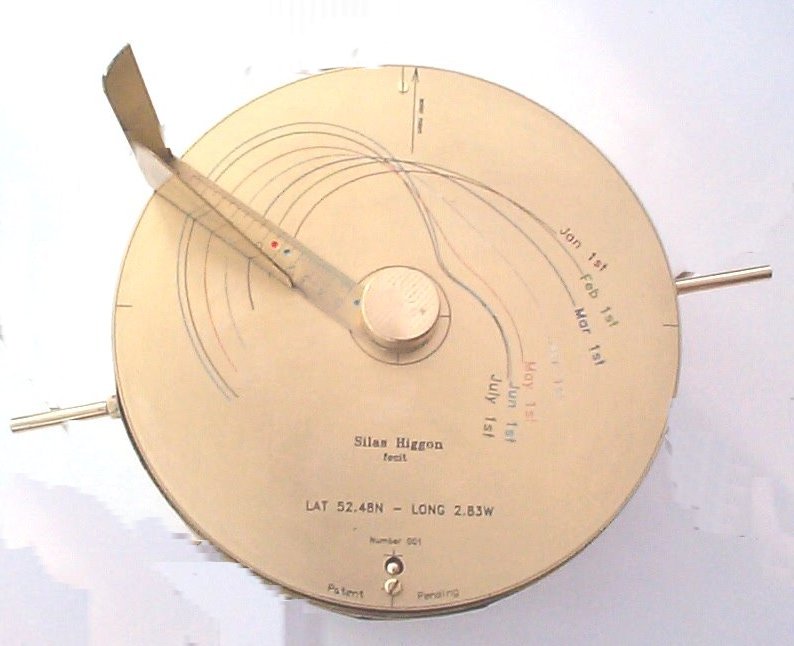
This dial is an entirely new concept in dial design.  It takes a reading of the sun's azimuth and, by means of a series of curves, finds the correction needed to bring the reading to clock time.  Each dial is designed for its own specific location and is etched with a serial number.   Individual inscriptions can also be incorporated at the design stage.


AZIbrassdisc.jpg (56055 bytes) AZIbrassbody.jpg (123647 bytes)
 

There is a patent, number GB0303560.7, pending on this design, and for those who might be interested a short description is given below:

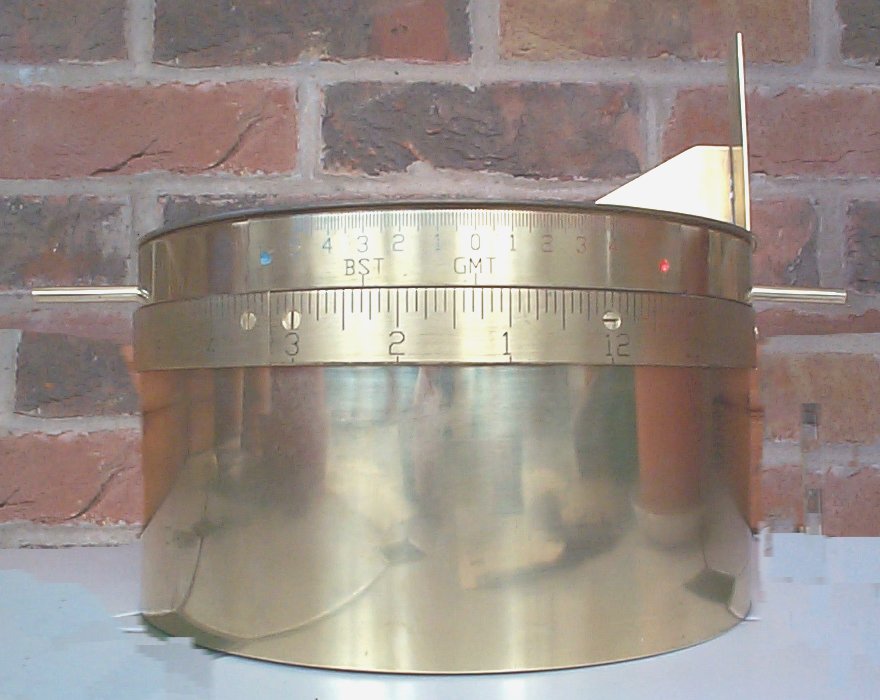
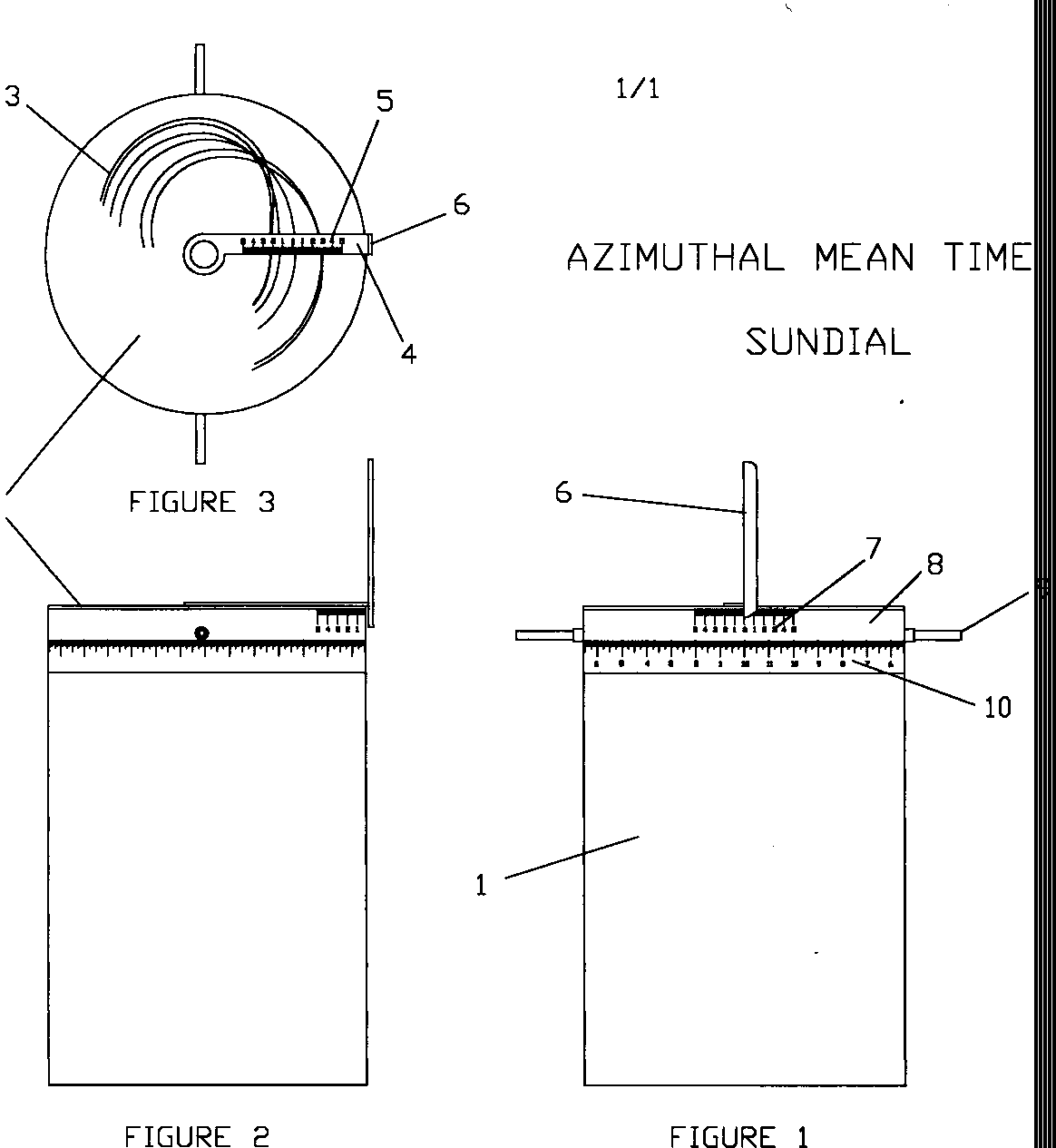
The dial consists of a cylinder (1) on top of which is a disc (2) having a series of curves (3) marked on its surface.  A finger (4) is free to rotate about the centre of the disc and has a correction scale (5) marked on its surface.  At the end of the finger is an alignment strip (6).  This casts a shadow along the finger when facing the sun and also extends a short distance below the finger to cover the scale (7) on the collar (8).  This collar is free to turn on the cylinder and below it is a time-scale (10) which is fixed to the cylinder.

To find the values for the correction curves it has been assumed that the azimuth angle for a given time is the same as the angle which that hour makes on the time-scale.  Any difference is then converted to a correction in minutes of time and noted. The scale starts at the north point which is midnight.  

patent.gif (24812 bytes)

EXAMPLE.  The sun's azimuth at London at 9am GMT on  1st July is 111.2 degrees.   This would indicate a time of 7.25am on the time scale and so a correction of +95 minutes would be required to bring it to clock time.  Calculations of this nature are made for each hour between sunrise and sunset for the first day of each month and the correction curves are then constructed using this data.  The amount of correction is also marked off on the finger (5) and on the collar (7).

To use the dial the finger is turned to face directly at the sun. This is shown when the shadow of the alignment strip (6) lies along the edge of the finger. 
A reading is taken from the finger scale corresponding to the date within the curves.  This reading is then transferred to scale (7) on the collar by turning the collar until the reading is in line with the bottom of the alignment strip.  Clock time is then read off the time-scale.